Not only the consignment note with its DeCA: these four tools use the same account and the same documents.
National consignment note
For domestic transport and cabotage in Spain: the sheet with the numbered boxes as always, which is also ready to be used as a DeCA when it carries the article 6 data.
The electronic version of the international consignment note under the CMR Convention, recognised by the forty-two states party to the Additional Protocol. The service is in twelve languages, and the other parties need no account to sign.
The control document for domestic transport and cabotage in Spain, on its own, when there is no consignment note to prepare: with its services, its electronic seal and its QR code.
Send the link to everyone involved. Each party reaches the action assigned to them, in real time. It opens straight from a phone, with no application to install.
Sign up with your email or with Google. No fee, no document limit and no commitment.
The same document, and the DeCA too.
The DeCA is for domestic transport and for cabotage in Spain.
And the document is the consignment note you already create in WeCMR: the DeCA is not another product.
When the transport is domestic and the collection and the delivery are in Spain, the assistant asks for what the DeCA needs: which box belongs to the contractual shipper and which to the actual carrier, and whether the special movement authorisation goes in box 18. With that, the sheet you were already making is ready to be used as a DeCA, with its QR code, if it carries the article 6 data and the other conditions the rule sets for the case are met.
And when there is no consignment note to prepare, create the DeCA on its own: you state whether your company is the contractual shipper or the actual carrier, add one or more services with their origin, destination and goods, and when you issue it the document gets its number, its electronic seal and its PDF with a QR code that always opens the newest version.
If your transport is international, this same sheet is your CMR consignment note or your eCMR, and the DeCA does not come into it.
Each country's national document is another matter: its rule either prescribes no form for the transport document, or requires a prescribed content, or adds a condition of signature or seal. What each country requires, with its source
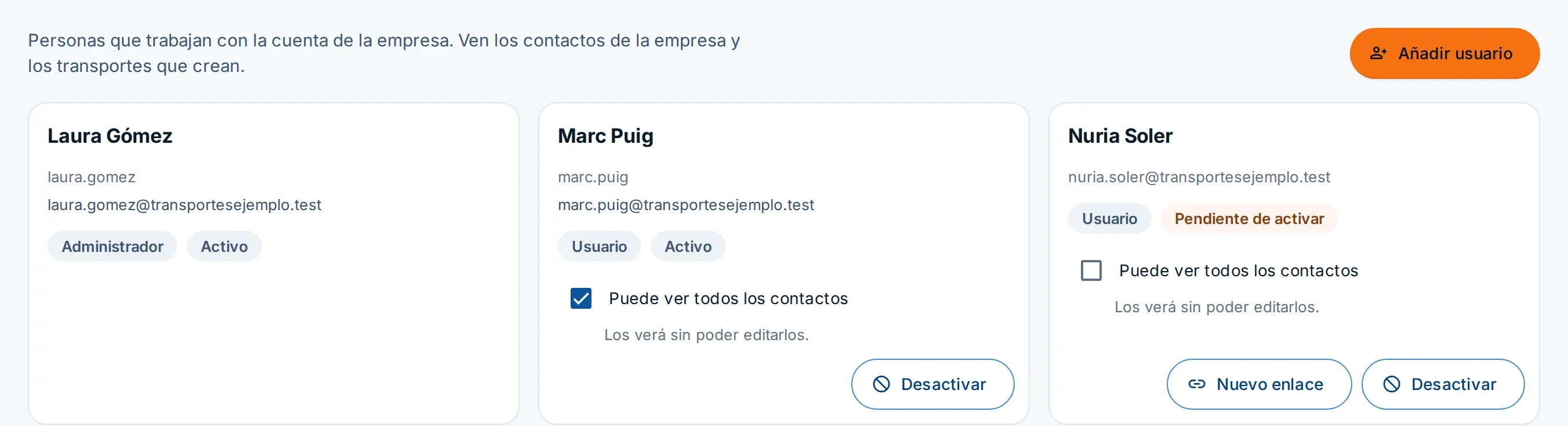
The account belongs to the company, and whoever you invite works on it: invite the people in your company with their e-mail address, give them their role and hand documents over when you need to.
Each person with their own user.
You add someone from the team by their e-mail address and share their activation link with them: they choose their password and join the same account. No shared credentials.
Administrator, user or reader.
The administrator manages the account, adds people and sees every document of the company. The others sign in with their own user and see the ones they manage; whoever administers decides whether each person sees the whole address book or only what they have saved.
A document changes hands.
If you go on holiday or change route, transfer the transport or the DeCA to a colleague: the list says who manages it, the history records it, and the account administrator can take the management back. The number, the PDF and the link do not change.
One numbering series for the whole company.
Transports and DeCAs are numbered by account and year, not by person: whoever in the team creates them, the series stays one.
Transfer a DeCA to a colleague.
The team, with each person’s role and state.
Screenshots of the application, taken in Spanish.
From the warehouse to delivery, stop by stop.
Creating, sharing and signing are the basics. This is what WeCMR does at each moment of the transport, so nobody types again what was already written or loses track of what changed.
Before departure
Your contacts, three letters away.
Every company you enter on a transport is saved in the address book under its tax number, with no extra steps. Next time, autocomplete offers it as you type and fills the box with its details.
A new transport from an existing one.
Copy a transport that repeats and keep the parties, the addresses and the goods. Signatures, dates, reservations and remarks stay with the original: the copy starts clean.
At loading
A portal for those without an account.
Senders and carriers who do not use WeCMR come in through a link or a QR code, without signing up. Each one sees only the actions that belong to their role and to that moment of the transport, and every action is sealed.
The handwritten signature, kept as evidence.
It is signed on the driver’s phone or from a link, also without an account. No image is stored: what is kept is the stroke with its timing, the time stamped by two independent timestamp authorities, and the location.
On the road
Changes that are proposed, accepted or rejected.
If the sender changes the delivery place or the consignee, or gives an instruction, the carrier holding the goods answers. Accepted, a new sealed version is born. Rejected, the reason is written down and the document does not change.
Lorry, driver or incident, recorded on the spot.
The carrier holding the goods changes the plate or the driver, or records a reservation or an incident, from their own link. There is no one to wait for: the change is sealed with who made it and when.
The handover between carriers.
The carrier in box 6 hands the load to the successive carrier in box 7, who accepts or rejects it from their link. Until they accept, the goods stay with the first, and at every moment only the one carrying them can act.
At delivery
Every file in its box, with its author.
Delivery notes, photos and accompanying documents are attached to the box they belong to and say who uploaded them. From the sheet itself they open at the roadside, without an account.
Every notice in the language of whoever receives it.
Each signature, proposal or answer notifies by email whoever it concerns, in their language. And when someone is waiting on you, the portal tells you as soon as you open the document.
In every version of the sheet
The sheet always up to date, and its history on page two.
The first page always shows the current data, in the numbered boxes of the CMR consignment note. From the second page on, every change in full detail: when, who, which box, the previous value, the new one and its status. Every version is kept as a file that is never rewritten.
One sheet, three readings.
Nobody signs three papers: what changes is not the document, but who reads it and under which rules.
one sheet
DeCA
The Spanish electronic administrative control document
Who inspects it
The authorities, at the roadside.
When
Mandatory in digital form from 5 October 2026, for domestic transport and cabotage within Spain.
How it works
Section Eight of the Resolución allows the DeCA to take the format of a consignment note, of an ADR transport document or of a waste identification document, provided it carries every item of data in article 6 of the Orden FOM/2861/2012.What matters is the data, not a hierarchy between documents.
Carta de porte
Who asks for it
Your customer, the insurer or a court.
When
Written form required for services above 150 €, and kept for one year.
eCMR
Who asks for it
Customers and authorities, across a border.
What it is
The electronic version of the international consignment note under the CMR Convention, recognised by the forty-two states party to the Additional Protocol. Using it stays optional.
Where it applies
In the forty-two states party to the Additional Protocol to the CMR. The official list, with its dates, is at the United Nations. Official list of states partyIt is used from any of them: the service is in twelve languages, and the other parties do not need an account to sign.And for a country's domestic carriage the same question applies: the rule admits any document carrying the data it lists itself, or it does not, or it adds a condition. What each country requires, with its source
Article 6, box by box.
The condition can be checked, so here it is checked: what the rule asks for, and where it lives on the sheet.
Who answers for it
Contractual shipper: name, tax number and address. Printed on the sheet.Box 1
Actual carrier: name and tax number. Printed on the sheet.Boxes 6 and 7
What moves, and where
Place of loading and place of delivery. Printed on the sheet.Boxes 3 and 4
Nature and weight of the goods. Printed on the sheet.Boxes 10 to 15
Date of carriage. Printed on the sheet.Boxes 3 and 21
What moves it
Tractor unit and trailer plates. Printed on the sheet.Box 6
Remarks. Printed on the sheet.Boxes 13, 18 and 24
Special movement authorisation. Printed on the sheet.Box 18
Checked against the data model on 1 September 2026. It is our own check on our own document, not anybody’s approval.
Every signature freezes the whole document.
Not a summary and not an extract. The complete sheet, exactly as it stood when it was signed.
Seal 01
Sender
Signs box 22 and freezes the whole sheet
Seal 02
Carrier
Signs box 23 and freezes the whole sheet
Seal 03
Consignee
Signs box 24 and freezes the whole sheet
ecmr-<uuid>-integrity-proof.zip
├── README.txtWhat this is and how to check it, step by step
├── manifest.jsonSigner, role, moment and SHA-256 of every file
├── seals/
│ ├── 01-SENDER.jwsThe seal, byte for byte as it was stored
│ ├── 01-SENDER.jsonThe document as it read at that signature
│ ├── 02-CARRIER.jws
│ ├── 02-CARRIER.json
│ ├── 03-CONSIGNEE.jws
│ └── 03-CONSIGNEE.json
└── certificate.pemThe certificate the seals were made with
What is inside the package any of the parties can download.
The seal contains the document
You can show what a party actually signed, years later, rather than what the record says today.
The chain is recomputed from the bytes in the file
It is not read from our database. If the chain is broken, the package says so.
It can be checked without us
Standard JWS tooling. Your expert can open it even if the platform no longer exists.
The platform seals with its own certificate, issued by no recognised authority, and the package itself says so inside. This section is about the integrity of the document, not about the identity of the signer or the level of the signature.
What it costs.
Right now, nothing.
There is no fee, no document limit and no minimum term. The service is in its test phase: free for an indefinite period and being calibrated.
One day it will stop being free, and we will tell you first. It will be announced by e-mail to every active account at least seven calendar days in advance, with the prices, the plans and the date it takes effect.
Anyone who does not accept the new terms will be able to download their documents and close their account at no cost, and will keep read-only access for the period stated in the notice, which will not be shorter than thirty days.
And if one day you leave: closing the account deactivates it, it does not delete it, and your documents stay there. A consignment note whose archived sheet is less than 366 days old cannot be deleted, so that no party is left without the evidence of the carriage. The document's QR code asks for no account: whoever has the link can keep seeing it. And the record of who signed what is kept for at least ten years.
Digital obligation from 5 October 2026, native PDF up to 5 MB, QR carrying the document URL, direct download without authentication, one year minimum retention, advanced signature at least where the DeCA is also used for a contractual purpose and has to be included signed, and section Eight on the consignment note format.
Entry into force on 5 December 2025 and transitional provision eight: the administrative control document of public road haulage of goods must be digital ten months later, which sets 5 October 2026.